The $100K Fee Won't Block Squarespace's H-1B Engineers. Your Layoffs Might
Hiring laid-off H-1B engineers from Squarespace? The $100K fee doesn't apply. The 60-day grace period and EO 14431's check on your own layoffs can block it.
If you want to hire the engineers Squarespace is laying off, you've probably already been warned about the $100,000 H-1B fee. That fee is the wrong thing to worry about. Two other things can actually stop the hire: a 60-day clock that DHS wants to get rid of, and an executive order that looks at your company's layoffs, not Squarespace's.
Squarespace is cutting about 300 people (19% of roughly 1,800). Most of the cuts are in product and engineering, and the company is giving extra support to affected staff on work visas.
The $100K fee does not apply to an in-country transfer
The $100,000 H-1B fee is not being collected, and even if it comes back it generally doesn't cover a worker who is already in the US and changing employers. A federal court in Massachusetts vacated the fee nationwide in June 2026, and the First Circuit refused to keep it in effect while the appeal runs.
An H-1B transfer is a change-of-employer petition: the new sponsor files an I-129 for someone who already holds H-1B status. The original fee was aimed at workers abroad and at petitions that ask for consular notification. Extensions, amendments, changes of employer and approved changes of status for people already in the US were generally left out. Proclamation 11069 (September 18, 2026) extends the fee to September 21, 2027, but it can't be collected while the court rulings stand.
There is also a separate proposed fee of $103,265, published August 25, 2026 and not yet final. It would hit all cap-subject petitions, meaning petitions that need one of the annual lottery numbers, including changes of status inside the US. A transfer for someone already counted against the cap normally isn't cap-subject. Confirm that with counsel for each candidate.
| Instrument | Status (Nov 2026) | Hits a US-based H-1B transfer? |
|---|---|---|
| $100K fee (original) | Vacated June 2026, not collected | Generally no |
| Proclamation 11069 extension | Runs to Sept 21, 2027, blocked by courts | Generally no |
| $103,265 proposed fee | Proposed Aug 25, 2026, not final | Only if cap-subject |
| Consular notification request | Your choice on the I-129 | Yes, so don't request it by mistake |
Here's the real fee risk. If someone checks the consular notification box on the petition when the candidate is in the US and only needs a change of status, the case can end up in the category the fee was written for. That's a paperwork mistake, not a policy problem.
Who is in Squarespace's engineering pool
The visible pool is about 208 US engineering and PM profiles, and a sample suggests it is mostly senior and mostly in New York. In Refolk's index of professional profiles, 208 US profiles have Squarespace in the headline and an engineering or PM title. In a sample of 25, every one was still at Squarespace: 11 Senior SWEs, 6 SWEs, 5 Staff SWEs and 2 engineering managers. 17 of the 25 were in New York City or Brooklyn.
The index shows who works there, not who is on the cut list. But with most of the cuts in product and engineering, and founder and CEO Anthony Casalena's memo calling for smaller teams and "more player-coaches," expect the people coming onto the market to look like this sample: experienced, and concentrated in one city.
| Segment | Count | Source |
|---|---|---|
| US eng/PM profiles with Squarespace in headline | 208 | Refolk's index |
| Senior + Staff share of sample (16/25) | 64% | Derived from sample |
| NY metro share of sample (17/25) | 68% | Derived from sample |
| US Senior SWE with "open to work" in headline | 54 | Refolk's index |
| US Entry-level SWE with "open to work" in headline | 124 | Refolk's index |
| Entry-to-senior ratio, "open to work" headlines | 2.3x | Derived |
The last two rows matter most if you're sourcing. In this index, 124 entry-level engineers have "open to work" in their headline against 54 senior ones, a 2.3x gap, so the people you want are the ones least likely to say they're looking. These are headline keyword matches, so they only count people who say it publicly, and the real numbers are higher. A Staff engineer on a visa with 16 weeks of severance usually won't announce a job search. They'll quietly answer the first recruiter who seems to know what they did.
That's where headline search falls short. You need everyone who worked at Squarespace, not just the people whose headline still says so. Refolk is built for this: you describe the person in plain English and get a ranked list, so someone whose headline only says "Senior Engineer, NYC" still shows up.
The 60-day clock is the real deadline, and it may disappear
The 60-day grace period is what lets a laid-off H-1B worker stay in the US long enough to change employers, and DHS has proposed eliminating it. The proposed rule, "Eliminating the Discretionary 60-Day Grace Period" (91 FR 57807, docket USCIS-2026-0364), was published September 11, 2026. The 60-day comment period closed November 10.
The grace period is up to 60 days after employment ends during which a nonimmigrant worker keeps status while they find a new sponsor or leave. It is a regulation DHS created in 2016, not a statute, so DHS can take it away without Congress. The proposal covers E-1, E-2, E-3, H-1B, H-1B1, L-1, O-1 and TN workers. They would have to leave immediately when the job ends unless they are otherwise authorized to stay.
Reddy Neumann Brown PC published a free comment template for the docket. Comments don't mean the rule will die. One law firm found no transition language covering someone who is already in a grace period when a final rule takes effect. That's the gap that matters for anyone Squarespace lets go this month.
If the grace period dies, an offer signed after the separation date may already be too late to file.
When does the clock actually start?
The 60 days start when employment ends, not when the layoff is announced. Squarespace is paying affected staff at least 16 weeks of base salary, with healthcare through May 2027. If that money comes as continued salary while the person is still employed, the clock may start months after a lump-sum payout would have started it. Ask every candidate one question before anything else: what is your official separation date? Then have counsel check how the severance is structured.
Why speed decides who gets the hire
Without a grace period, Ogletree warns that workers "would likely be unable to change status or change employers" unless USCIS uses favorable discretion. In that case the only safe path is an offer and a filing before the separation date. A team that can file within days gets the candidate. A team with five interview rounds loses them to whoever moved first, or to a flight home. The shortlist is the one step you can build before the layoff is final, so build it now.
EO 14431 checks your layoffs, not Squarespace's
Executive Order 14431 tells agencies to look at whether the hiring employer laid off similarly situated US workers in the past year or plans to. It isn't about the employer the candidate is leaving. Squarespace's 300 cuts don't count against you. Your own March cut does.
The order asks whether the sponsor "directly or indirectly engaged in layoffs within the previous year or plans future layoffs" affecting similarly situated US workers. It applies at every stage:
- LCAs (Labor Condition Applications, the wage-and-conditions attestation filed with DOL before the petition)
- Petitions, including extensions
- Visa stamping at consulates
- Admission at the border
The order doesn't define "similarly situated" or "layoffs," and no agency has issued guidance yet. It doesn't ban filing after layoffs either. DOL had to start reviewing past LCAs within 30 days. Sairah Saeed of Manifest Law sums it up: employers with past or planned layoffs "should expect increased scrutiny by USCIS."
The headcount trap
Layoffs also change your ratios. If you cut US staff and keep H-1B staff, your H-1B share goes up. As the Klug Firm points out, once it passes the H-1B-dependent threshold (about 15%), you have to make non-displacement attestations, which are formal promises that you didn't and won't displace US workers to make room for the hire.
Take a founder who cut 20 engineers in March and wants to hire two ex-Squarespace staff engineers in November. That founder is exposed twice: once under EO 14431's 12-month lookback, and again if the March cut pushed the company over the dependency line. Hiring two people who were laid off elsewhere can look, on paper, like replacing your own laid-off workers with visa holders.
The scrutiny follows your existing H-1B staff too
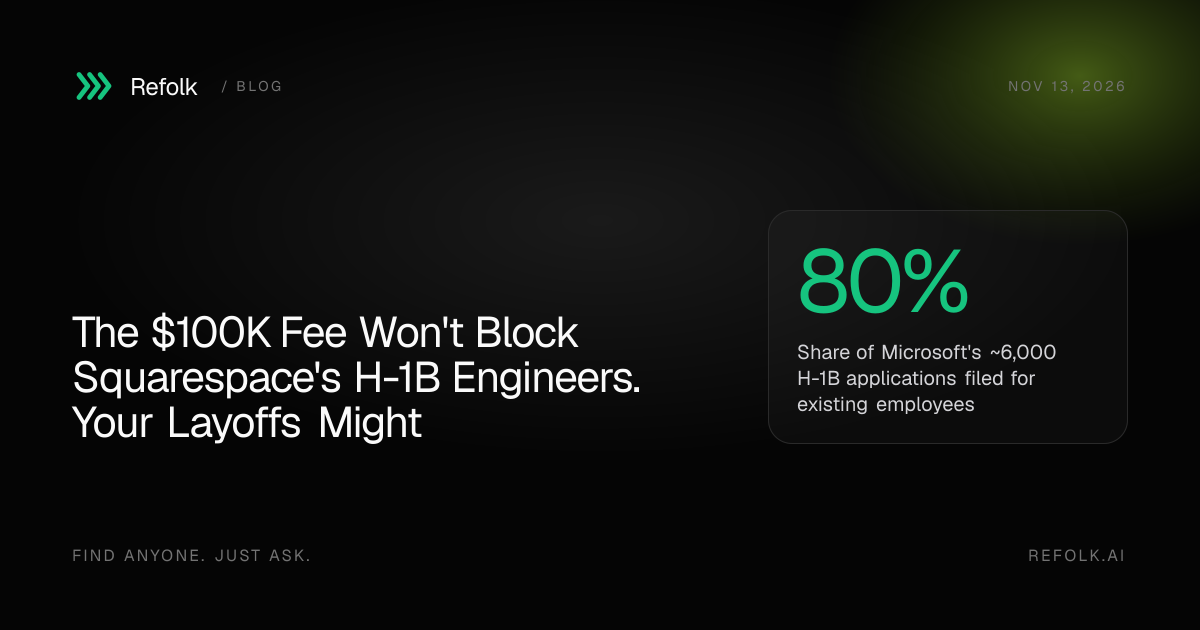
Under EO 14431, an extension for an H-1B employee you already have is a new I-129 petition, so a company with recent layoffs takes on scrutiny for its whole visa workforce, not just new hires. Microsoft shows the scale. By its own count, 80% of its roughly 6,000 H-1B applications were for existing employees.
On October 8, 2026, JD Vance and Labor Secretary Keith Sonderling suspended eight firms from PERM sponsorship, Microsoft and Adobe among them. PERM is the labor certification step that starts most employment-based green cards. Microsoft's defense was that most of its filings were for people it already employed. It was suspended anyway.
The enforcement looks selective, not formulaic. Amazon had 19,178 H-1B approvals in FY2025, the most of any sponsor, and has cut 30,000 corporate jobs since October 2025. It wasn't suspended. Meta, with 6,294 approvals, wasn't either. Don't assume a smaller company with a quieter layoff will get the same pass.
| Employer | H-1B figure | PERM suspended Oct 8? |
|---|---|---|
| Amazon | 19,178 approvals (FY2025) | No |
| Meta | 6,294 approvals (FY2025) | No |
| Microsoft | ~6,000 applications, 80% for existing staff | Yes |
| Adobe | Not cited | Yes |
A filing-first playbook for hiring laid-off H-1B workers
To hire laid-off H-1B workers safely in November 2026, make the offer and file before the separation date, clear your own layoff history with counsel first, and keep the petition a plain change of employer. In order:
- Audit yourself before you source. List every reduction in the past 12 months and any that are planned. Work out your H-1B share after those cuts and check it against the dependency threshold.
- Write down why the role isn't a backfill. If you cut engineers in March, explain in writing how this role differs in scope, stack or team.
- Get the separation date on the first call. Ask whether severance is paid as continued salary or a lump sum, and work backward from that date.
- Shorten the loop. Two technical conversations and a decision within a week. Plan for the grace period not existing.
- File as a change of employer with change of status. Make sure nobody requests consular notification on the I-129.
- Check cap status per candidate. Confirm with counsel that the transfer isn't cap-subject in case the $103,265 proposal becomes final.
- Plan your extensions. Before taking on a new filing, check which of your current H-1B employees come up for extension in the next year.
Most teams can do steps 1, 2 and 5 in an afternoon with their immigration lawyer. Sourcing is what stalls. A senior req can sit open for weeks while a recruiter scrolls headlines for people who never post "open to work," and by then a Squarespace engineer's separation date may already have passed. An agency fee won't make that faster.
FAQ
Does the $100,000 H-1B fee apply when I hire a laid-off H-1B worker already in the US?
Generally no. A Massachusetts federal court vacated the fee nationwide in June 2026 and the First Circuit refused to keep it in effect during the appeal, so it isn't being collected. Even when it was in force, changes of employer and changes of status for people already in the US were generally excluded. The risk is asking for consular notification by mistake, which puts the petition in the category the fee targets.
Does the 60-day grace period still apply after an H-1B layoff?
Yes, for now. A laid-off H-1B worker can stay in status for up to 60 days after employment ends while a new employer files a petition. DHS proposed eliminating the grace period on September 11, 2026, and comments closed November 10. Until a final rule is published, the grace period still applies, but one law firm found no transition language for people already inside it when a rule lands. Treat it as fragile and file early.
What does Executive Order 14431 mean for H-1B hiring after layoffs?
It tells agencies handling LCAs, petitions, visas and admission to consider whether the sponsoring employer laid off similarly situated US workers in the past year or plans to. It doesn't ban filing, and the key terms aren't defined yet. In practice, a company with recent layoffs should expect more scrutiny of new petitions and of extensions for its current H-1B staff.
The data behind this
Try it on the search you came here for
Stop building boolean strings. Just describe the person.
Type one sentence. I plan the search, read GitHub, public LinkedIn and Crunchbase records, and the open web as it is right now, and hand back a ranked list with the reason next to every name.
01Describe them
One plain sentence. Role, city, stack, stage, whatever matters to you.
02I read the web live
GitHub, public LinkedIn and Crunchbase records, the open web. Not a database that went stale last quarter.
03You read the shortlist
Ranked, with the reasoning under every name. Open a profile, ask a follow-up, narrow it down.
- Staff backend engineers in NYC who shipped Rust in production
- Series A fintechs in SF under 50 people, growing headcount this year
- Maintainers of fast-growing Rust web frameworks on GitHub
- No boolean, no filters, no seat to buy. One box.
- Read at search time, so a profile updated yesterday counts today.
- Every step visible as it runs, every name with its reason.
500 free credits on sign-up. No card, no demo call. See real searches.