Amazon Cut 250 in Devices. Search Lab126, Not 'Amazon Devices'
Amazon cut about 250 devices jobs on Oct 28, 2026. Search Lab126, not Amazon Devices, and sign offers before the 90-day internal window closes in January.
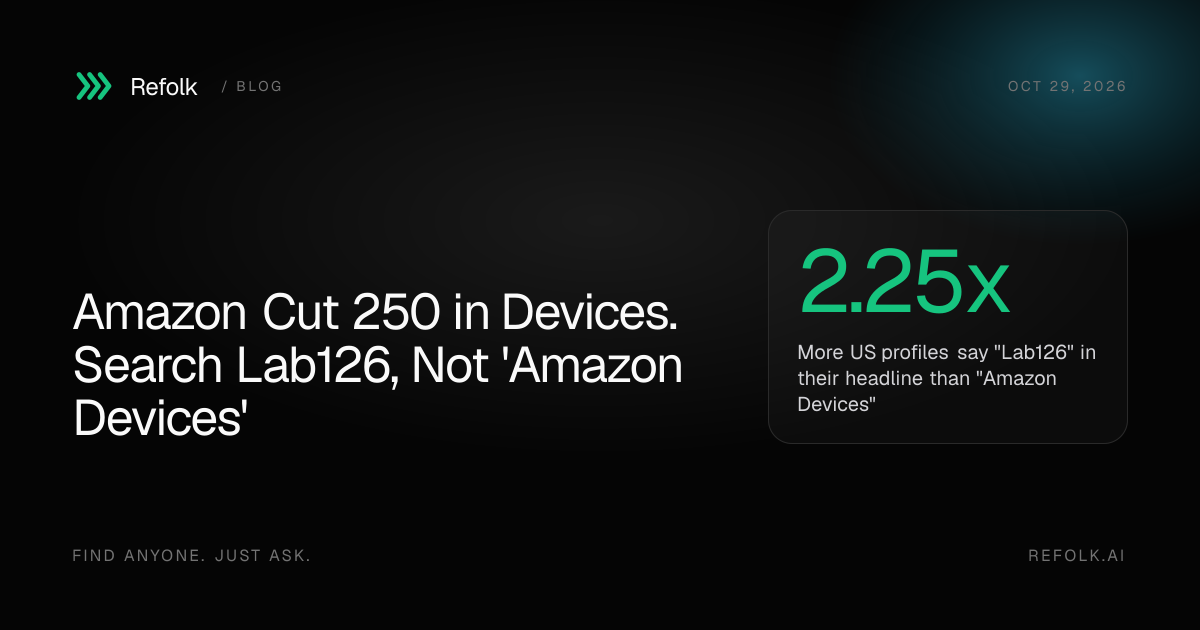
On October 28, 2026, Amazon cut about 250 people from its devices and services unit. Most were software developers, and Amazon confirmed the cut only after Reuters asked about it. If Amazon follows its recent pattern, each of those people has about 90 days to find another job inside Amazon while Amazon's own recruiters put them first. Outside hirers have until late January, and most will lose the first week searching the wrong company name.
What did Amazon cut in its devices unit in October 2026?
Amazon cut no more than 250 jobs in devices and services, mostly in software development, according to a person familiar with the matter quoted by Reuters on October 28, 2026. The cut landed right after weeks of Kindle e-reader and tablet launches.
What's on the record:
- Who broke it: Greg Bensinger at Reuters. Amazon confirmed only after Reuters contacted it.
- How notices went out: by text and email from Cherie Robinson, HR VP for devices and services. They cited "a thorough review of our structure."
- Timing: the cut came after weeks of Kindle e-reader and tablet launches. On the same day, Amazon announced an Alexa alarm clock and a photo frame.
- Context: earlier in October, Amazon cut about 1,000 jobs in its core retail division. Q3 earnings followed on October 29.
Think about the scale this way. Amazon Lab126, the Sunnyvale subsidiary that built the Kindle, Fire TV, Echo and Astro, has about 3,000 employees. If all 250 cuts landed there, that would be about 8% of the subsidiary. That's an upper bound, not a fact. The cuts may well reach into the wider devices org. Either way, the headline number of 250 undersells how concentrated this talent is.
How does Amazon's 90-day internal transfer window affect outside hirers?
Amazon's recent corporate layoffs gave most US employees 90 days to find another internal role before severance kicked in, and Amazon's recruiters prioritize internal candidates during that time. For this round, that points to a separation date around January 26, 2027.
The evidence for that pattern:
- Amazon's January 2026 layoff message offered "most US-based employees 90 days to look for a new role internally," with severance only after that.
- In October 2025, Amazon said its recruiting teams "will prioritize internal candidates."
- The January 2026 round was announced in late January. Its WARN notice set effective dates of April 28, exactly 90 days later.
October 28 plus 90 days is about January 26, 2027. Any WARN filings for this round would likely show up in December 2026 or January 2027. One caveat: Amazon hasn't published the window or the separation date for this round. January 26 assumes the pattern holds.
The internal-first rule turns the window into a draft. Internal hiring managers pick first, and the strongest engineers get picked early. By late January, the people left are a mix of those no internal team wanted and those who decided they were done with Amazon. From outside, you can't tell which is which.
There's also extra pull back inside. In late September 2026, Amazon started approaching former employees about AI and cloud roles. Amazon is recruiting its own alumni at the same moment it's cutting devices staff.
Why does searching "Amazon Devices" find the wrong people?
In Refolk's index of US professional profiles, 1,850 people mention "Lab126" in their headline, against 821 who mention "Amazon Devices." That's a 2.25x gap. The bigger difference is who each search returns: engineers for Lab126, mostly finance and marketing staff for Amazon Devices.
Here's what a 25-profile sample of each search looks like:
| Search | US total | At Amazon now (sample) | Main geography (sample) | Typical titles |
|---|---|---|---|---|
| Headline "Lab126" | 1,850 | 52% (13/25) | 80% Bay Area | SDE, ASIC, battery, applied science, Vega OS SDK |
| Headline "Amazon Devices" | 821 | 76% (19/25) | 28% Seattle, 12% Bay Area | Finance director, CFO, marketing, product |
| Embedded/firmware titles | 351 | Amazon not in top 10 | Austin, Sunnyvale, Cupertino, San Diego | Firmware Eng, Embedded SW Eng |
The Lab126 sample reads like a hardware team's org chart: SDE, Senior ASIC Engineer, Staff Mechanical Engineer (Battery), Sr. Applied Scientist, and "Senior Software Development Manager, Application Framework and SDK, Vega OS." The Amazon Devices sample has finance directors, a CFO and marketing heads, mostly in Seattle. Lab126 headlines are concentrated in the Bay Area about 6.7x more than Amazon Devices headlines (80% versus 12%).
The reason is how people label themselves. Engineers tend to write the legal entity they badge into, and Lab126 is a real subsidiary at 1100 Enterprise Way, Sunnyvale. Business-function staff tend to write the org they report into. The samples are small, so treat the percentages as directional. The direction is clear, though.
Engineers write the badge they swipe. Finance writes the org chart. Search accordingly.
Which search terms find Kindle, Fire TV and Alexa engineers?
To find these engineers, search the subsidiary name, the platform names and the product names, each paired with an engineering title. Don't search the division name.
The terms that work:
- "Lab126": the subsidiary name, and the single best keyword for this group.
- "Vega OS": Amazon's Linux-based, React Native operating system. It replaces the Android-based Fire OS on new Fire TV sticks, and Amazon says all future sticks will run it.
- "Kepler": the earlier name of the Vega developer tools. Engineers who worked on early builds may still use it.
- Product names: Kindle, Fire TV, Echo, Astro, always combined with a title so you don't pull in product marketers.
- Titles: SDE, Firmware Engineer, Embedded Software Engineer, ASIC Engineer, Applied Scientist.
Vega OS is worth singling out. Amazon says every future Fire TV stick will run it, so the people who built its application framework and SDK hold experience on a platform very few engineers outside Amazon have touched.
Getting this right in Boolean is tedious. You need "Lab126" in the headline or past experience, an engineering title, a Bay Area location, and an exclusion for the Seattle finance people, all repeated across LinkedIn, GitHub and personal sites. Refolk skips the string-building: you describe the person in plain English and get back a ranked shortlist from all three sources, including people who wrote "Lab126" and never wrote "Amazon" at all.
Why are embedded firmware engineers from Kindle and Alexa so rare?
Only 351 US profiles in Refolk's index match Firmware Engineer or Embedded Software Engineer with "embedded firmware" in the headline, and Apple is the top current employer in that sample. When a Lab126 firmware engineer comes onto the market, that's a rare event. It isn't one more name in a crowded pool.
What the sample shows:
- Apple: 7 of 25 profiles.
- Meta: 3 of 25.
- Amazon: not in the top 10.
- Geography: spread across Austin, Sunnyvale, Cupertino and San Diego.
- Titles: Firmware Engineer (12) and Embedded Software Engineer (11) dominate.
Amazon's absence from that list probably says more about job titles than about headcount. The Lab126 sample is full of SDE titles, so engineers there who do firmware work may never write the word "firmware" in their headline, and a narrow firmware search will undercount them. The query was deliberately narrow, so read 351 as a signal of scarcity, not a census.
The practical consequence: if you're hiring an embedded engineer, you're competing with Apple and Meta for a pool of a few hundred people, and the 90-day clock runs whether or not you've started.
How can Lab126 alumni help you reach the engineers who were just cut?
Nearly half of the Lab126 sample (12 of 25) already works somewhere other than Amazon, at companies like Meta, AMD, Archer and Airbnb, or at hardware startups they founded. These alumni are your warmest route to the people cut on October 28.
Alumni know which teams did what, who was strong, and who just got a notice. A message passed along by a former teammate also tends to land better than a cold one from a stranger. And the spread of alumni shows that outside companies are already hiring from this pool, so you aren't the only one who has noticed.
A simple playbook:
- Find people with Lab126 in their past experience who now work somewhere other than Amazon.
- Prioritize the ones who left most recently. Their former teams are the likeliest to overlap with this round.
- Ask for introductions to specific teams (Vega OS, Fire TV, Kindle, Echo), not "anyone good."
- Make the referral worth their time.
Step 1 is a reverse search, and it's awkward in most tools because you're filtering on past employer while excluding current employer. In Refolk you can just ask for people who left Lab126 and now work at hardware startups, and you get the referral map in one pass.
When should you make offers to laid-off Amazon engineers?
Aim to have offers signed in weeks 4 to 8 of the window, roughly late November to late December 2026, with start dates after the estimated January 26, 2027 separation. Candidates stay on Amazon's payroll during the window, so a start date after separation costs them nothing.
| Date | Day of window | What to do |
|---|---|---|
| Oct 28 to Nov 18, 2026 | 0 to 21 | Map Lab126 alumni, run outreach, start screens |
| Nov 25, 2026 | ~28 (week 4) | Start extending offers |
| Dec 2026 to Jan 2027 | ~35 to 90 | Watch for WARN filings, if any |
| Dec 23, 2026 | ~56 (week 8) | Target for signed offers |
| Jan 26, 2027 (est.) | ~90 | Estimated separation; earliest start date |
Waiting doesn't work, for three reasons:
- Internal-first drains the top of the pool. Amazon's recruiters prioritize internal candidates, so the best engineers get internal offers first.
- Amazon is also pulling people back from outside. Since late September 2026, it has been approaching former employees about AI and cloud roles.
- WARN filings come too late. If any appear, they'll likely land in December or January. Useful for confirming locations, too late for planning around.
Be honest with candidates about one thing. Many will keep looking for an internal role while they talk to you, since severance only comes after the window closes. Don't fight that. Make your offer concrete enough, with scope, team and a start date just after separation, that it compares well with whatever Amazon's internal teams put in front of them in January.
FAQ
How many people did Amazon lay off in its devices unit in October 2026?
About 250, according to a person familiar with the matter quoted by Reuters on October 28, 2026, mostly in software development. Amazon confirmed the cut only after Reuters asked, and the notices came from Cherie Robinson, HR VP for devices and services. It followed about 1,000 cuts in Amazon's core retail division earlier the same month.
When will laid-off Amazon devices engineers actually be available to start?
If Amazon repeats the 90-day internal transfer window from its earlier rounds, separation would fall around January 26, 2027. Amazon hasn't published the date for this round, so treat it as an estimate. Candidates stay on payroll until then, so the cleanest plan is an offer signed in December with a start date just after separation.
Is Lab126 the same thing as Amazon Devices?
Lab126 is an Amazon subsidiary at 1100 Enterprise Way, Sunnyvale, with about 3,000 employees. It built the Kindle, Fire TV, Echo and Astro, and Panos Panay, SVP of Devices, is listed as a key person. "Amazon Devices" is the broader business org. In Refolk's index, the Lab126 label returns mostly Bay Area engineers, while the "Amazon Devices" label returns mostly Seattle finance and marketing staff.
Should I wait for WARN notices before sourcing?
No. In the January 2026 round, the WARN notice set effective dates exactly 90 days after the announcement. For this round, any filings would likely show up in December 2026 or January 2027, by which time internal teams will have had weeks to hire the strongest engineers. Use WARN data to confirm locations, and source from Lab126 headlines and alumni now.
The data behind this
Try it on the search you came here for
Stop building boolean strings. Just describe the person.
Type one sentence. I plan the search, read GitHub, public LinkedIn and Crunchbase records, and the open web as it is right now, and hand back a ranked list with the reason next to every name.
01Describe them
One plain sentence. Role, city, stack, stage, whatever matters to you.
02I read the web live
GitHub, public LinkedIn and Crunchbase records, the open web. Not a database that went stale last quarter.
03You read the shortlist
Ranked, with the reasoning under every name. Open a profile, ask a follow-up, narrow it down.
- Staff backend engineers in NYC who shipped Rust in production
- Series A fintechs in SF under 50 people, growing headcount this year
- Maintainers of fast-growing Rust web frameworks on GitHub
- No boolean, no filters, no seat to buy. One box.
- Read at search time, so a profile updated yesterday counts today.
- Every step visible as it runs, every name with its reason.
500 free credits on sign-up. No card, no demo call. See real searches.